
Session 2: Prompt Engineering & Vibe Coding in Production
Date: August 22, 2025
Duration: 90 minutes
Presenters: Damien Li, Eden Ye
Recording: Watch Session Recording
📋 Overview
Session 2 explored two critical aspects of modern AI development: advanced prompt engineering techniques from Anthropic and practical strategies for implementing Vibe Coding in production environments. Damien Li presented insights on prompt engineering best practices, while Eden Ye covered the latest developments in large language models.
The session featured in-depth analysis of how to transform conversational AI interactions into reliable, production-ready task executors, drawing from real-world experiences at Anthropic.
🎯 Key Topics Covered
1. Latest AI News & Technical Reports
Recent Developments:
DeepSeek-V3.1 Release: Stepping into the Agent Era
- Introduces
UE8M0 FP8parameter precision scale - Designed specifically for upcoming next-generation domestic chips
- Read the announcement
- Introduces
Google I/O 2025: Major announcements for AI development
Key Technical Reports:
Kimi K2: Open Agentic Intelligence
ChatGPT Agent: Bridging Research and Action
Qwen3-Coder: Agentic Coding in the World
Context Engineering for AI Agents: Lessons from Building Manus
- By Yichao 'Peak' Ji
- Read the article
Research Papers:
- DeepSeek: "Native Sparse Attention: Hardware-Aligned and Natively Trainable Sparse Attention" - arXiv
- Kimi: "MoBA: Mixture of Block Attention for Long-Context LLMs" - arXiv
- MiniMax: "MiniMax-01: Scaling Foundation Models with Lightning Attention" - arXiv
2. Advanced Prompt Engineering (Anthropic Methodology)
The Paradigm Shift: From Conversation to Task Instruction
The key challenge in production AI systems is moving beyond simple conversational prompts that lead to:
- Unstable outputs
- Misinterpretations (e.g., car accident reports confused with skiing accidents)
- Lack of confidence in results
- Difficulty in automation
The Golden Structure of Quality Prompts
A high-quality prompt is like a comprehensive task briefing with a specific structure:
1. Define Role & Task
- Assign the model an expert persona
- Example: "You are a professional AI claims adjuster responsible for reviewing Swedish traffic accident reports."
2. Set Tone & Style
- Establish behavior guidelines, especially for handling ambiguous information
- Example: "Your analysis must be fact-based and confident. If information is insufficient for judgment, explicitly state this rather than guessing."
3. Inject Background Knowledge
- Provide constant, unchanging information directly to the model
- Include fixed form structures, document templates, and business rules
- Benefits:
- Improved efficiency (no need to parse common structures repeatedly)
- Higher accuracy (pre-understanding structure enables better extraction)
- Cost optimization (ideal for prompt caching)
4. Use Structural Delimiters
- Employ XML tags (
<document>,<example>) or Markdown to clearly separate sections - Why: XML tags help models better understand and reference specific information blocks
- Example: Wrap form structure descriptions in
<form_structure>tags
5. Provide Step-by-Step Instructions
- Break complex tasks into ordered, logical steps
- Instruction order is critical
- Example workflow:
- Carefully examine the accident report form and list all checked options
- After understanding the form content, analyze the hand-drawn accident diagram
- Combine information from both sources for comprehensive analysis and final judgment
6. Provide Quality Examples (Few-Shot Learning)
- For tricky, ambiguous, or error-prone edge cases, provide complete input-output examples
- One of the most powerful tools for guiding model behavior
- Use XML tags like
<example_case>and<example_output>to wrap examples
7. Reinforce Key Instructions
- Repeat the most important rules at the end of the prompt
- Prevents "instruction drift" in long prompts
- Example: "Important reminder: Your final conclusion must strictly rely on provided documents, only making judgments when highly confident."
8. Define Output Format
- Force the model to return results in specific, machine-readable formats (e.g., JSON)
- Wrap final answers in specific XML tags
- Example: "Please wrap your final conclusion within
<final_verdict>tags."
9. Pre-fill Response (Advanced)
- Directly provide an opening for the model's response in the API call
- Effective technique for forcing specific output structures (especially JSON)
- Example: In the API request's "assistant" section, directly fill in an opening brace
{
Key Resources:
3. Vibe Coding in Production
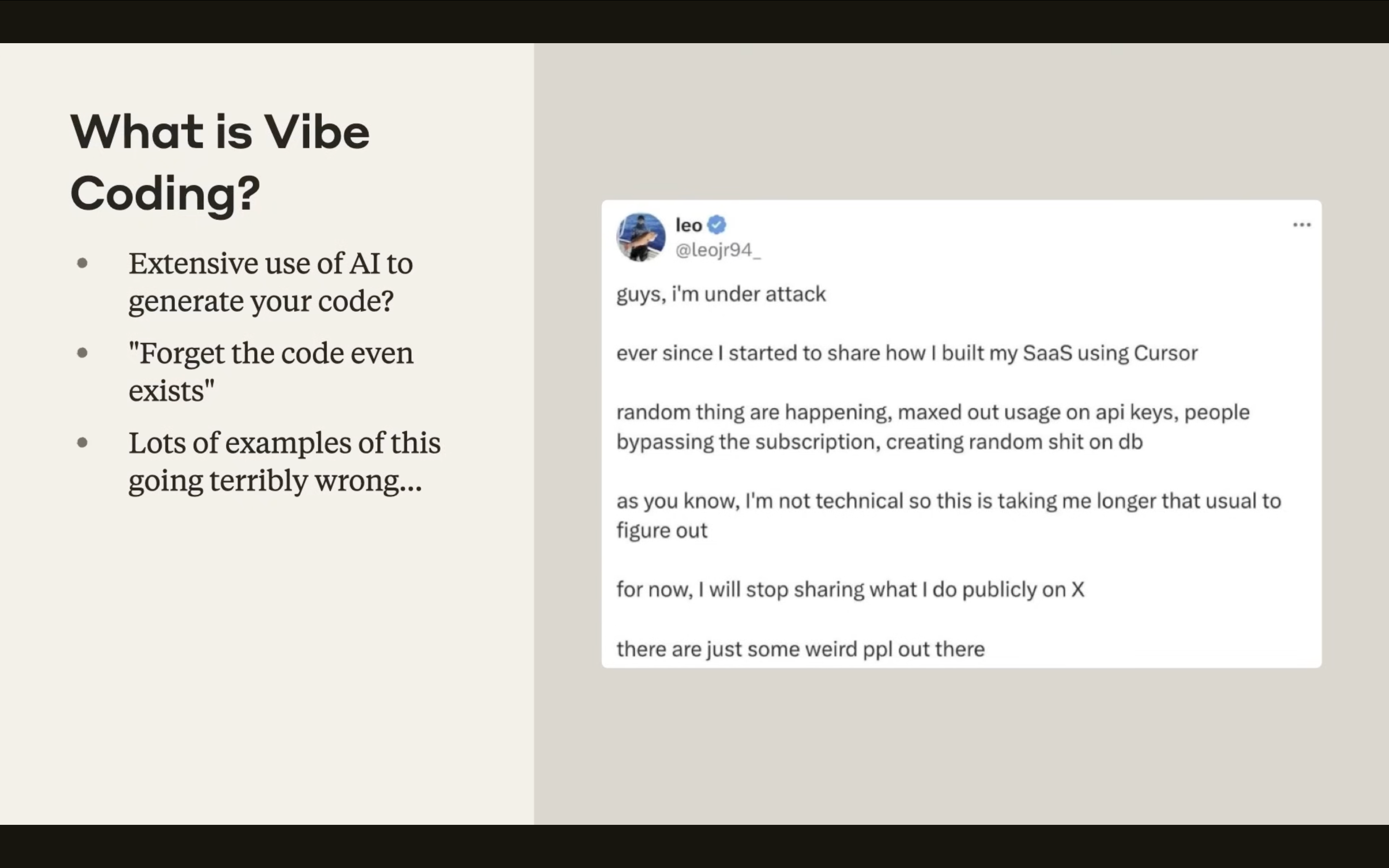
Presented by: Erik Schulntz (Anthropic Coding Agent Researcher)
What is TRUE Vibe Coding?
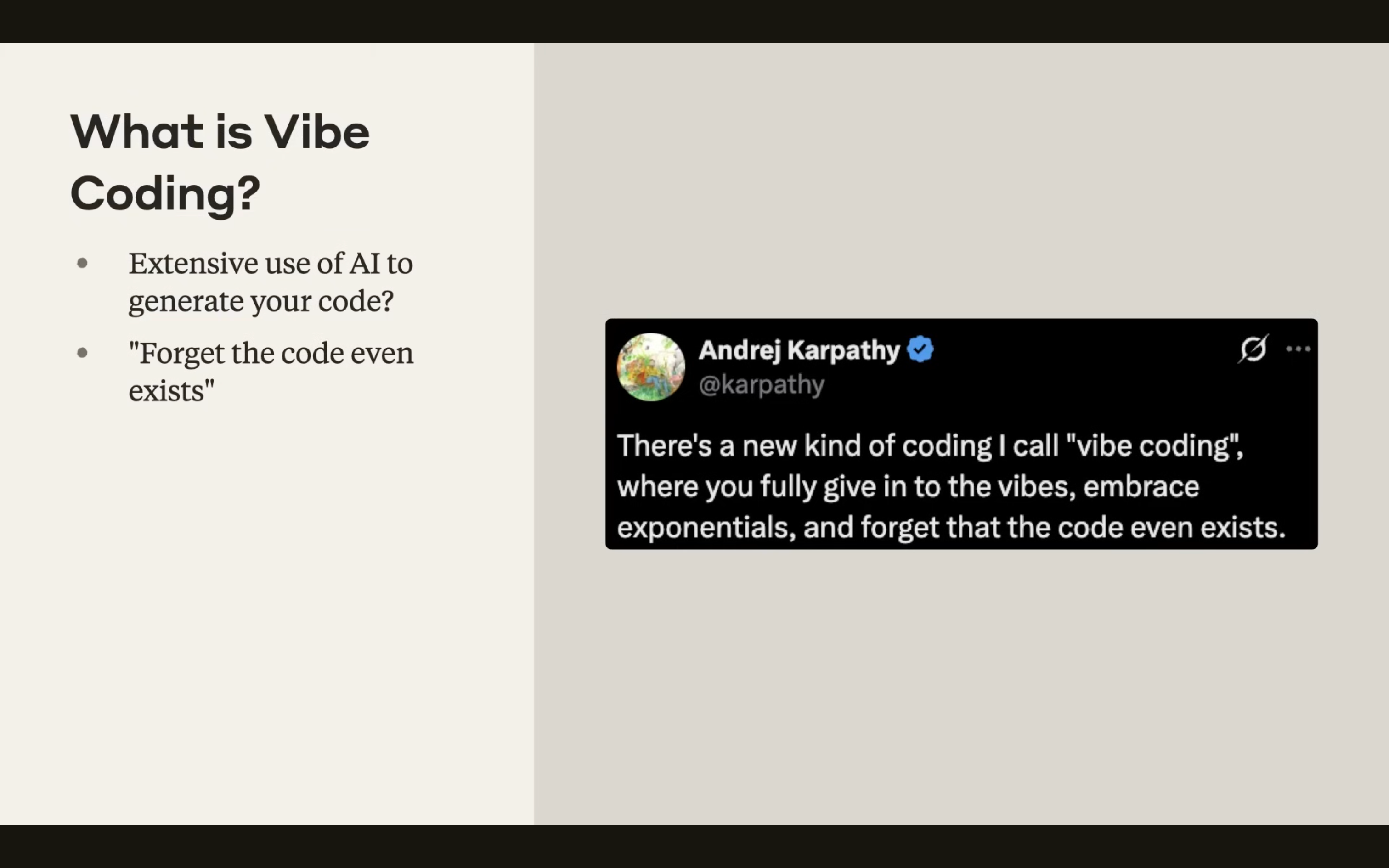
Many people misunderstand Vibe Coding. Simply using AI to generate large amounts of code is NOT Vibe Coding. If you're just using Copilot or Cursor to generate code, review it manually, ask AI for modifications, and iterate — that's not Vibe Coding.
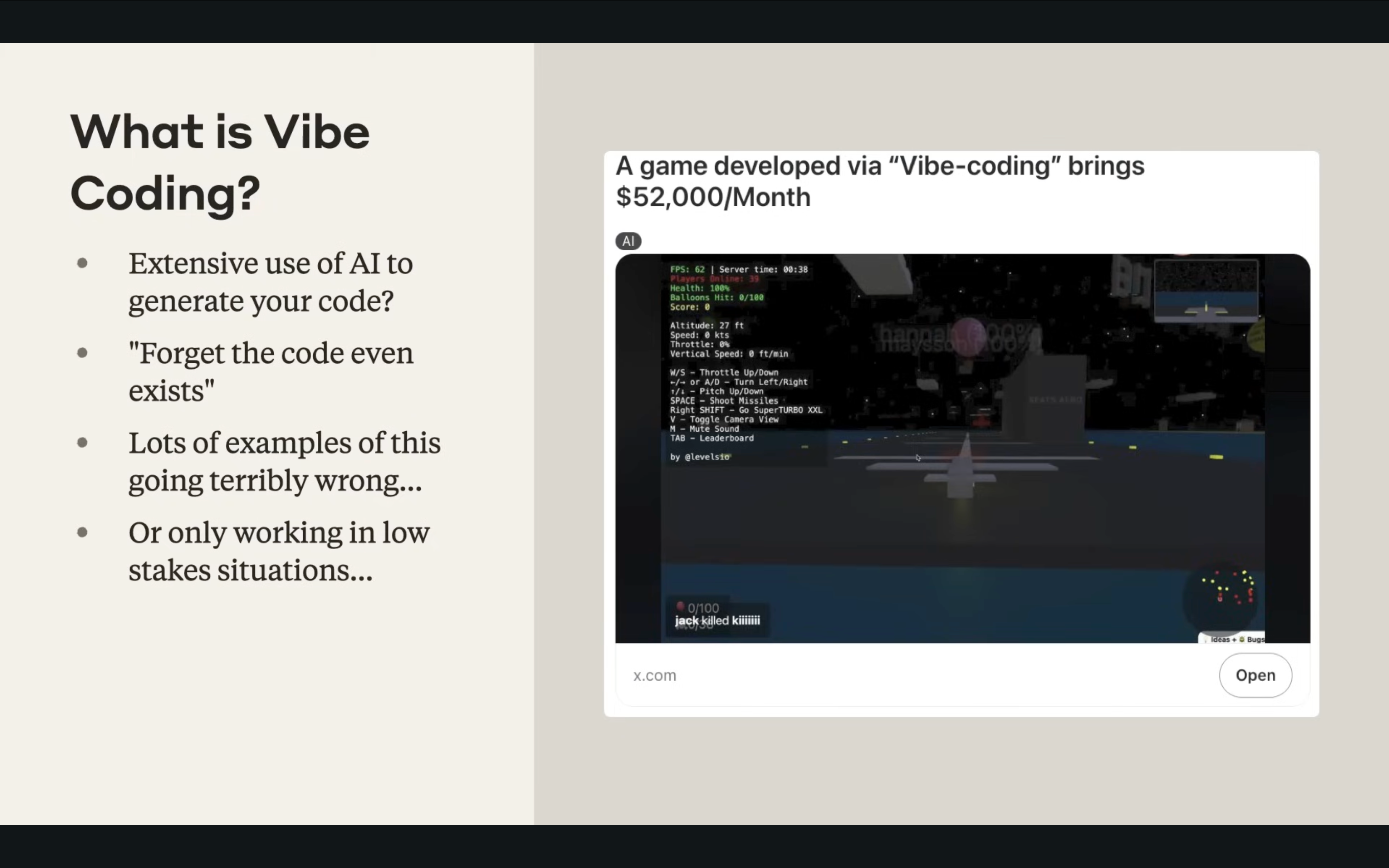
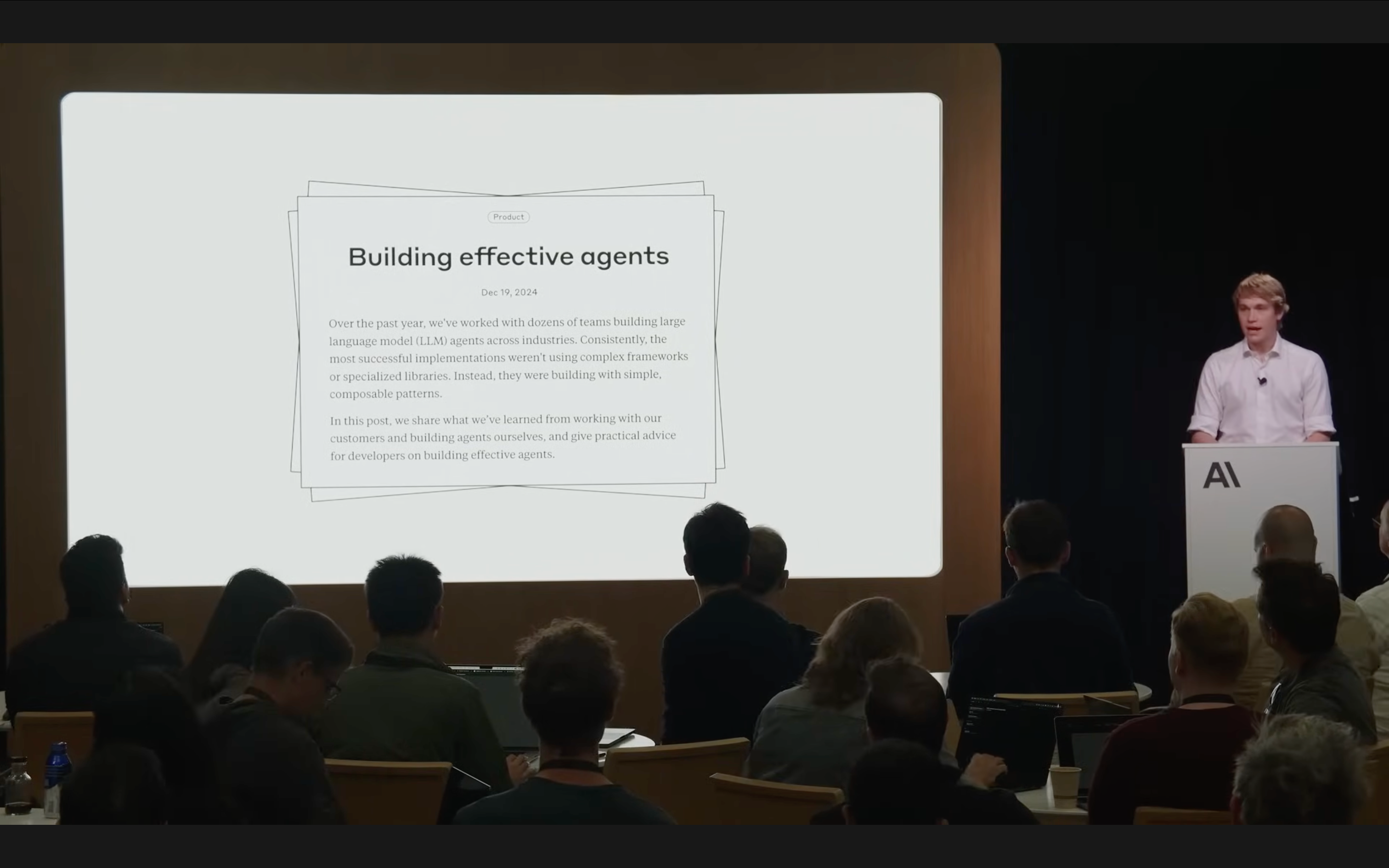
True Vibe Coding, as originally proposed by Andrej Karpathy, means forgetting code exists entirely. Through Vibe Coding, non-technical people can develop complete applications — an exciting possibility that opens new opportunities for many.
Current Challenges:
- Non-technical people can't understand what AI is doing, leading to helplessness when problems arise
- Currently works well only for low-risk projects (small games, toy projects)
- Code quality issues in complex systems can have serious consequences
Why Focus on Vibe Coding?
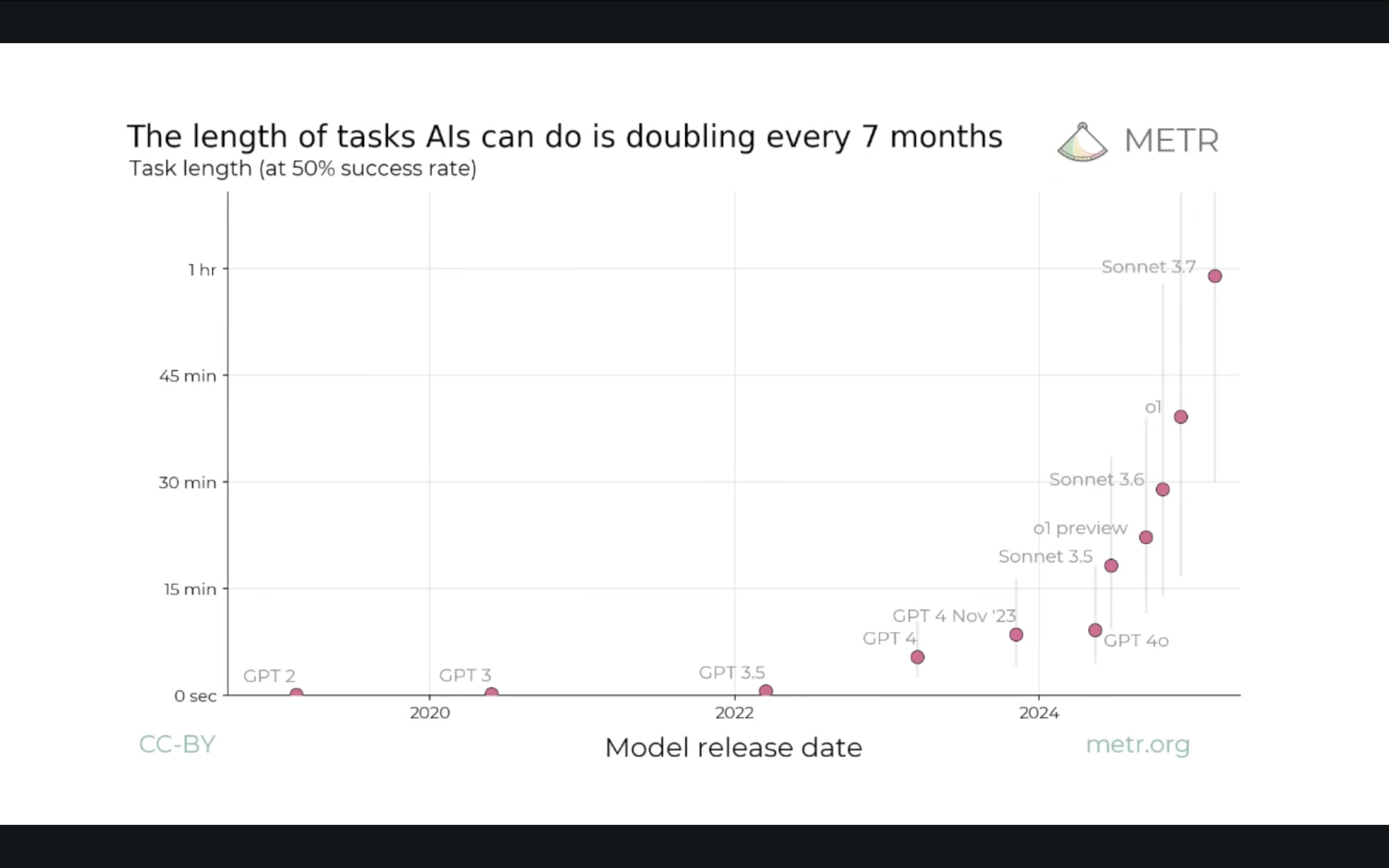
Exponential Growth: AI capabilities double approximately every 7 months.
Today, AI might handle 1-2 hours of coding work, which we can review line by line. But what about next year? In a few years? When AI can generate a day's or week's worth of code, line-by-line review becomes impractical.
The Compiler Analogy:
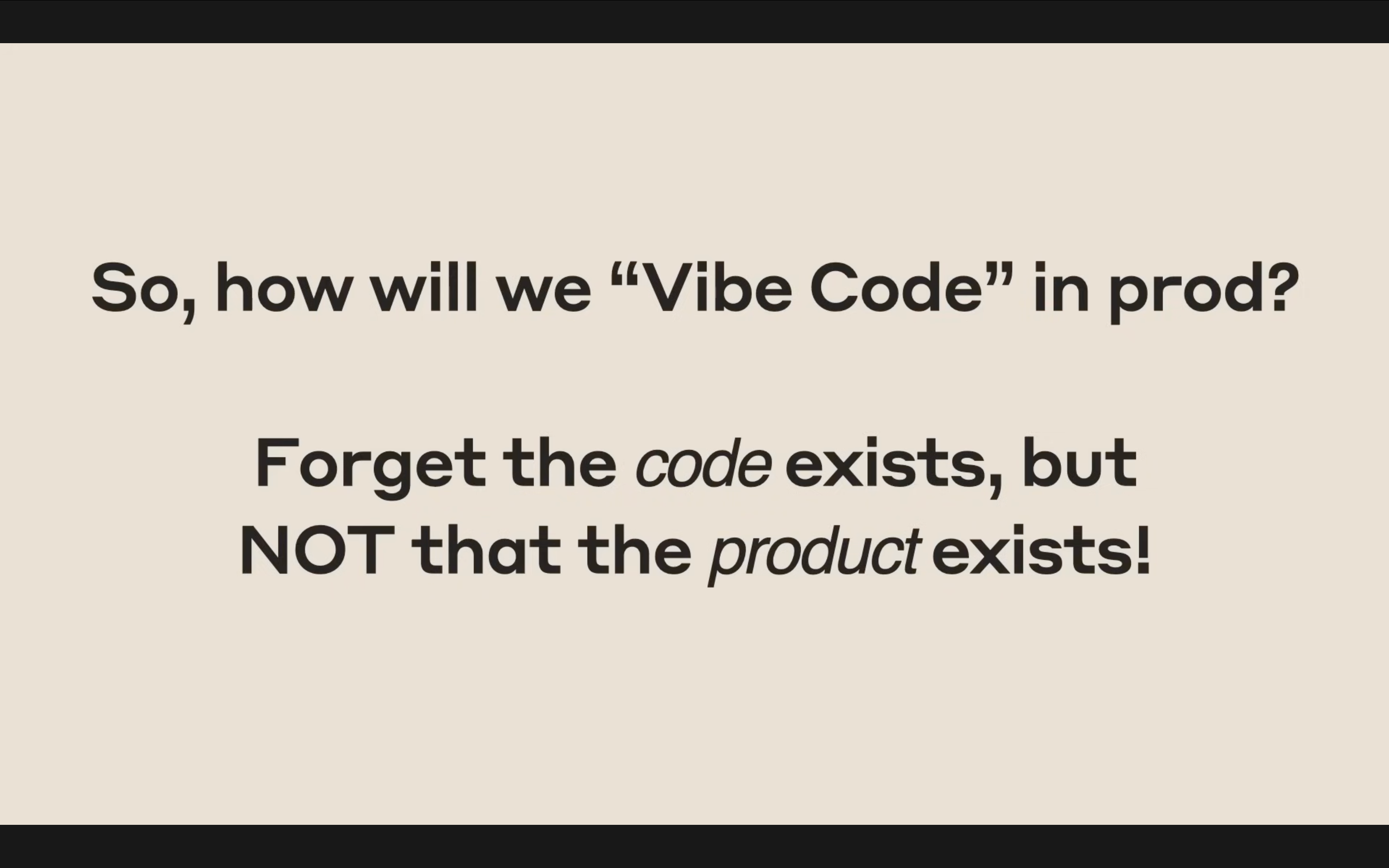
When compilers first emerged, they had bugs, limited optimization, and many developers checked or even hand-wrote assembly code. But as project complexity increased, this became impractical. Developers had to trust compilers completely and ensure product quality at the code level.
Similarly, with Vibe Coding, we should forget code exists and find ways to ensure quality at the product level.
Lessons from Other Industries:
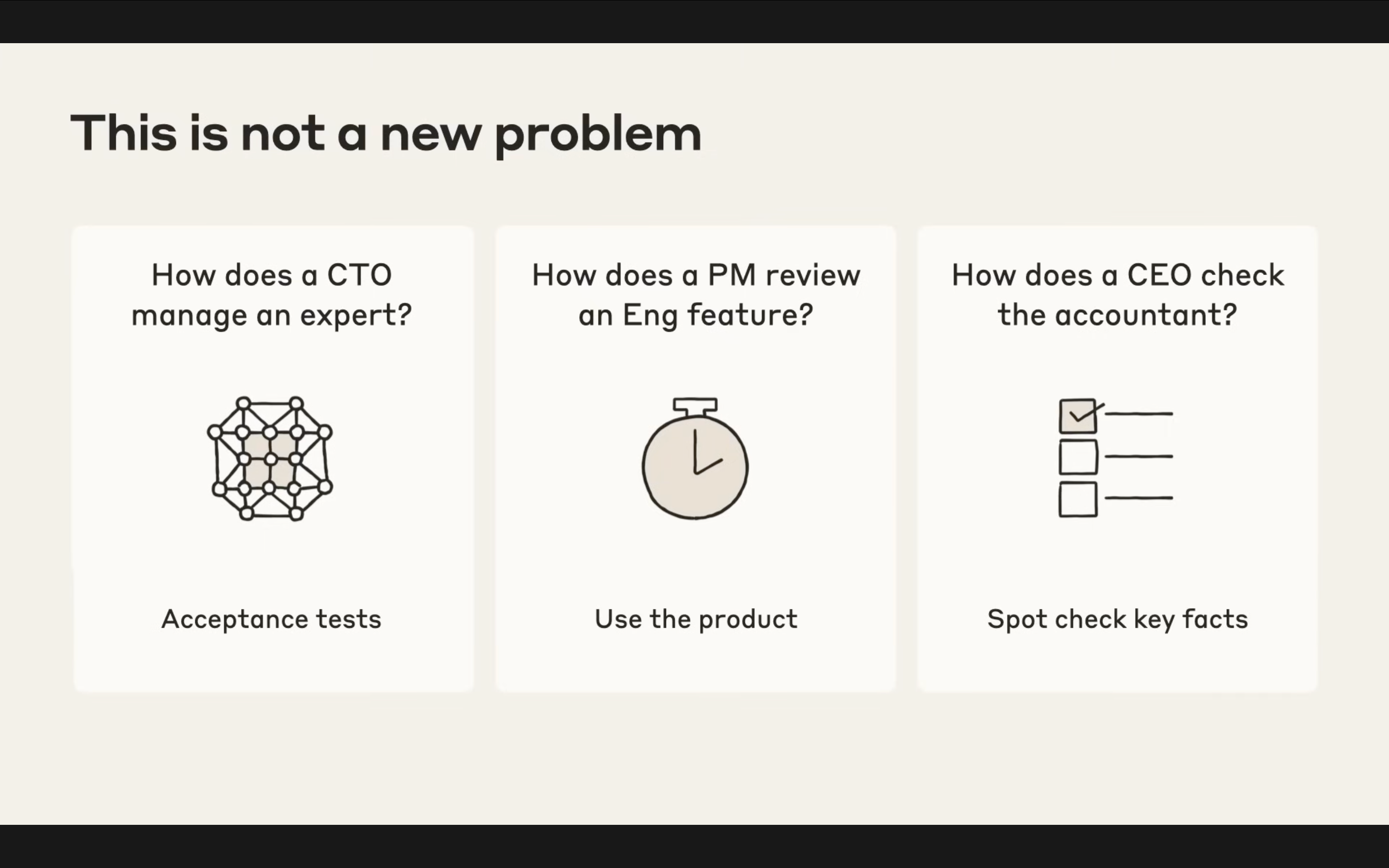
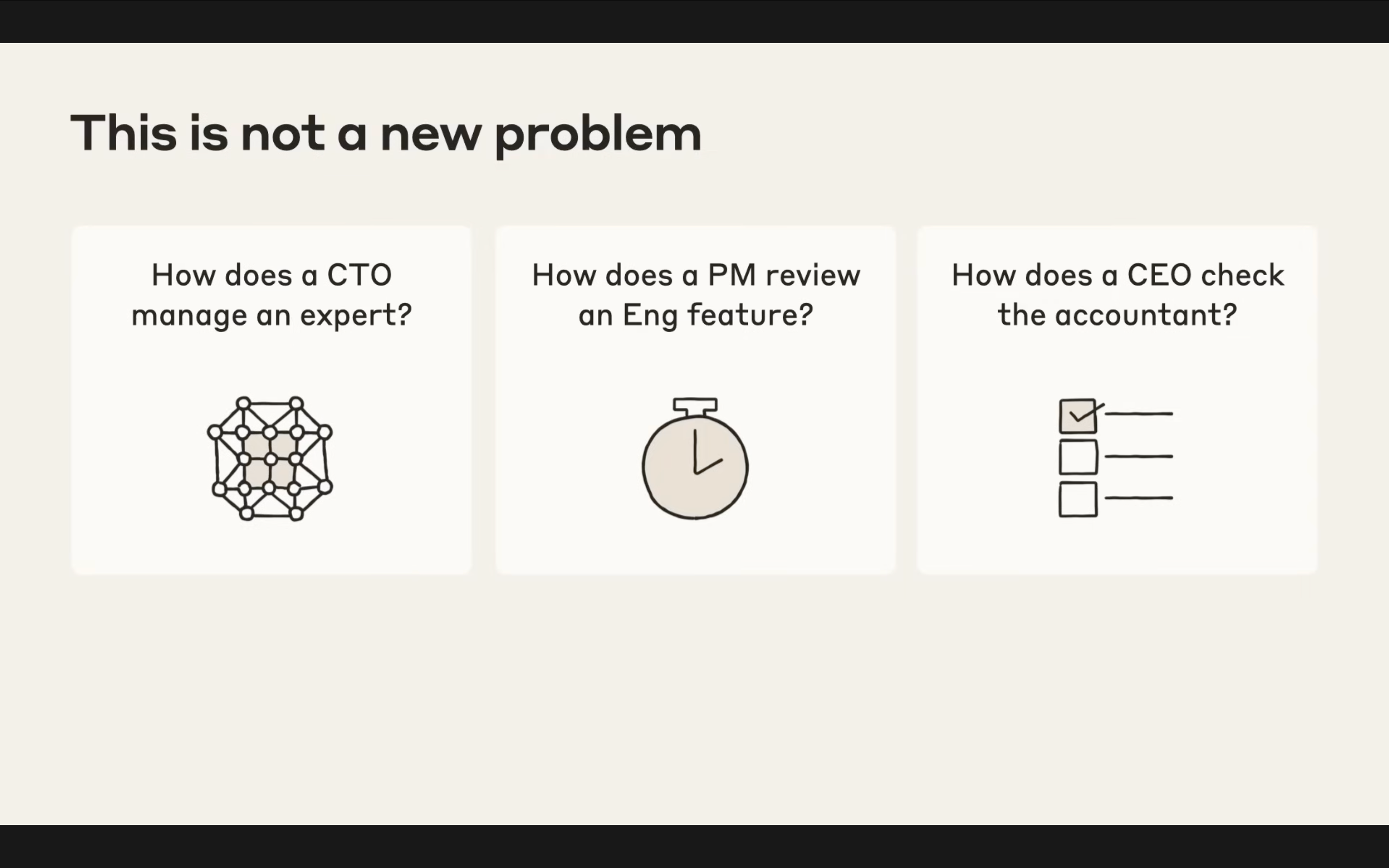
- CTOs don't deeply understand every domain — they manage experts through acceptance tests
- Product Managers don't know code — they verify functionality works as expected through product experience
- CEOs aren't financial experts — they spot-check key facts and data points
The universal question: How do you manage what you don't understand?
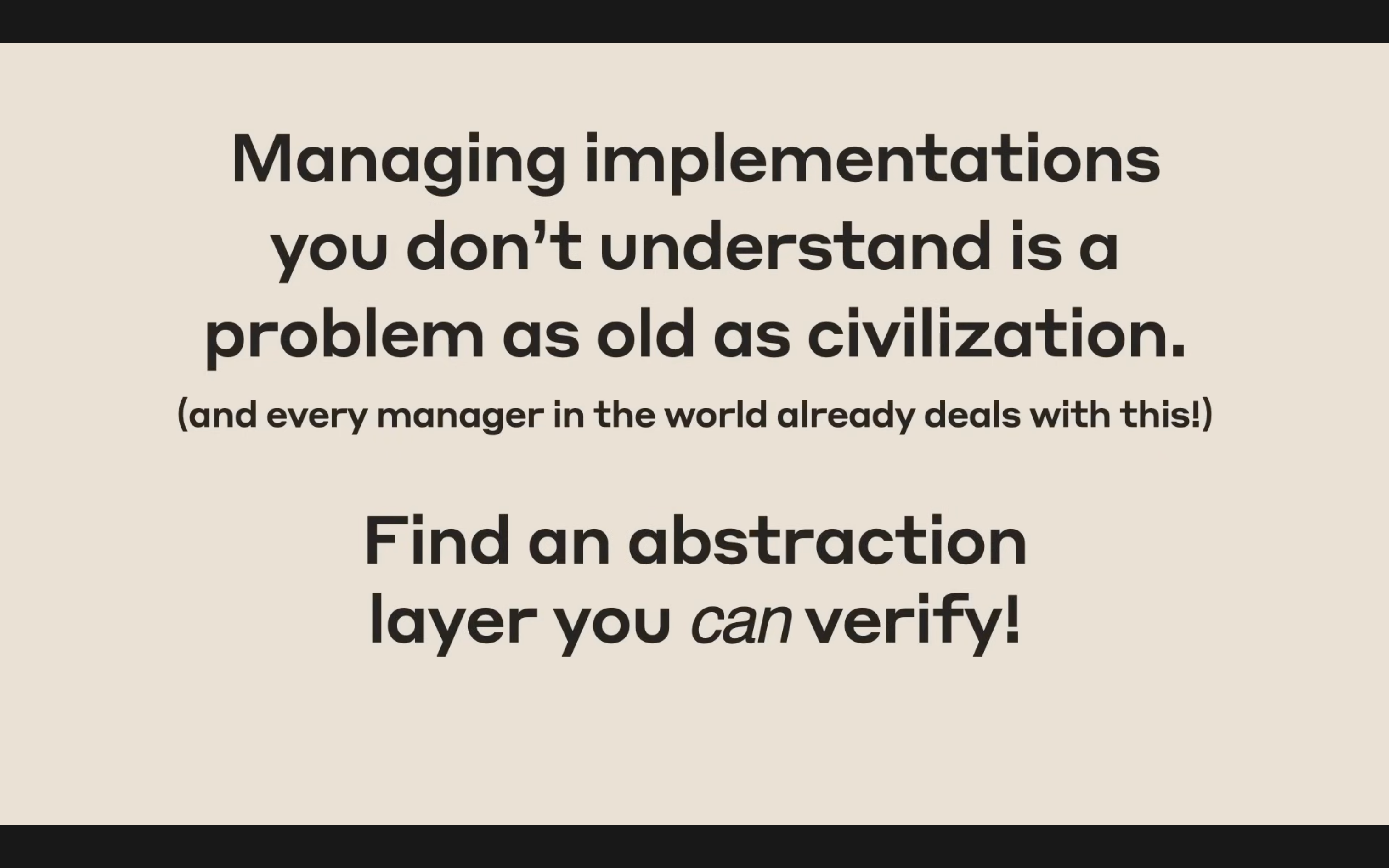
Answer: Find the abstraction layer you CAN verify.
Practical Vibe Coding Strategies:
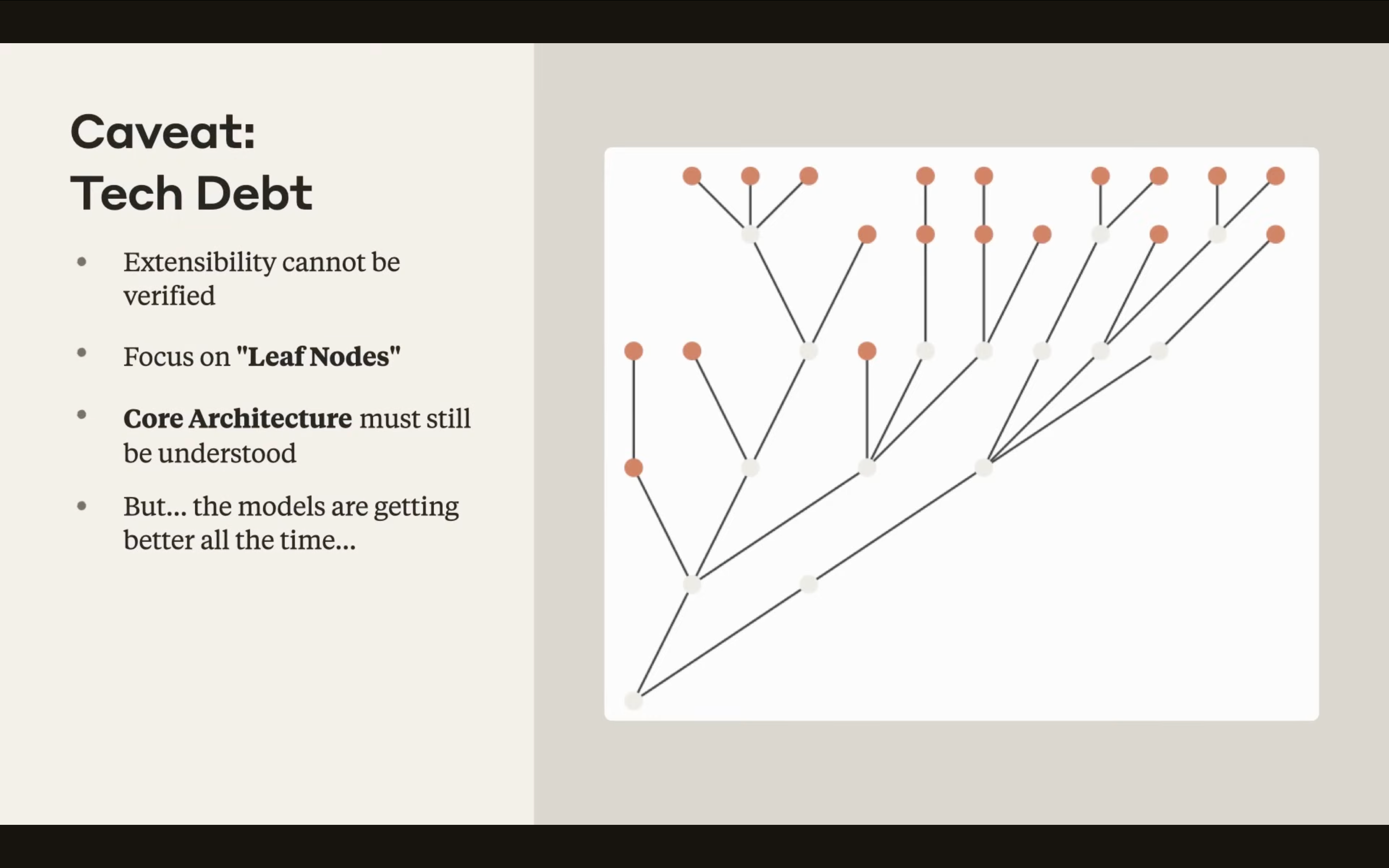
Apply Vibe Coding to Leaf Nodes:
- Use Vibe Coding for features with no dependencies (leaf nodes in the codebase tree)
- Even if problems arise, impact is contained
- For core/branch nodes, maintain AI generation + human review
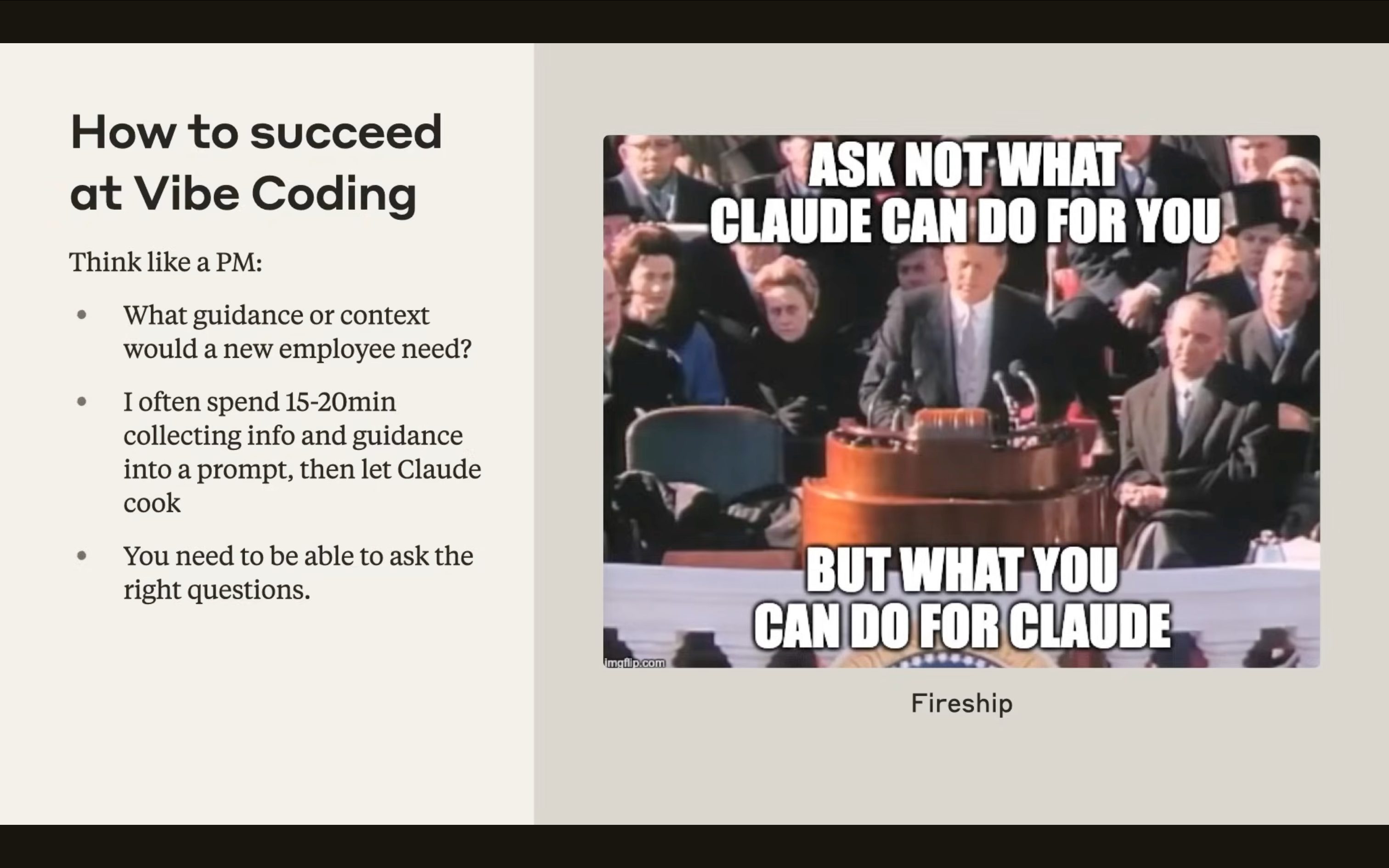
Act as the Boss:
- Don't ask Claude what it can do — ask what YOU can provide
- Provide sufficient context: project architecture, requirements, constraints
- Spend time gathering information and composing comprehensive prompts
Require Technical Background:
- Need technical expertise to ask the right questions and provide guidance
- Non-technical people can't yet Vibe Code large commercial projects
Real Production Example:
Successfully merged 20,000+ lines of AI-generated code into production:
- Pre-development: Discussed implementation approach and details with AI, created comprehensive prompts
- Leaf nodes: Let AI complete directly (lower code quality acceptable)
- Core code: AI generation + detailed human review
- Testing: Carefully designed stress tests to ensure system stability
- Verification: Designed easy-to-read inputs/outputs — verify correctness without reading code
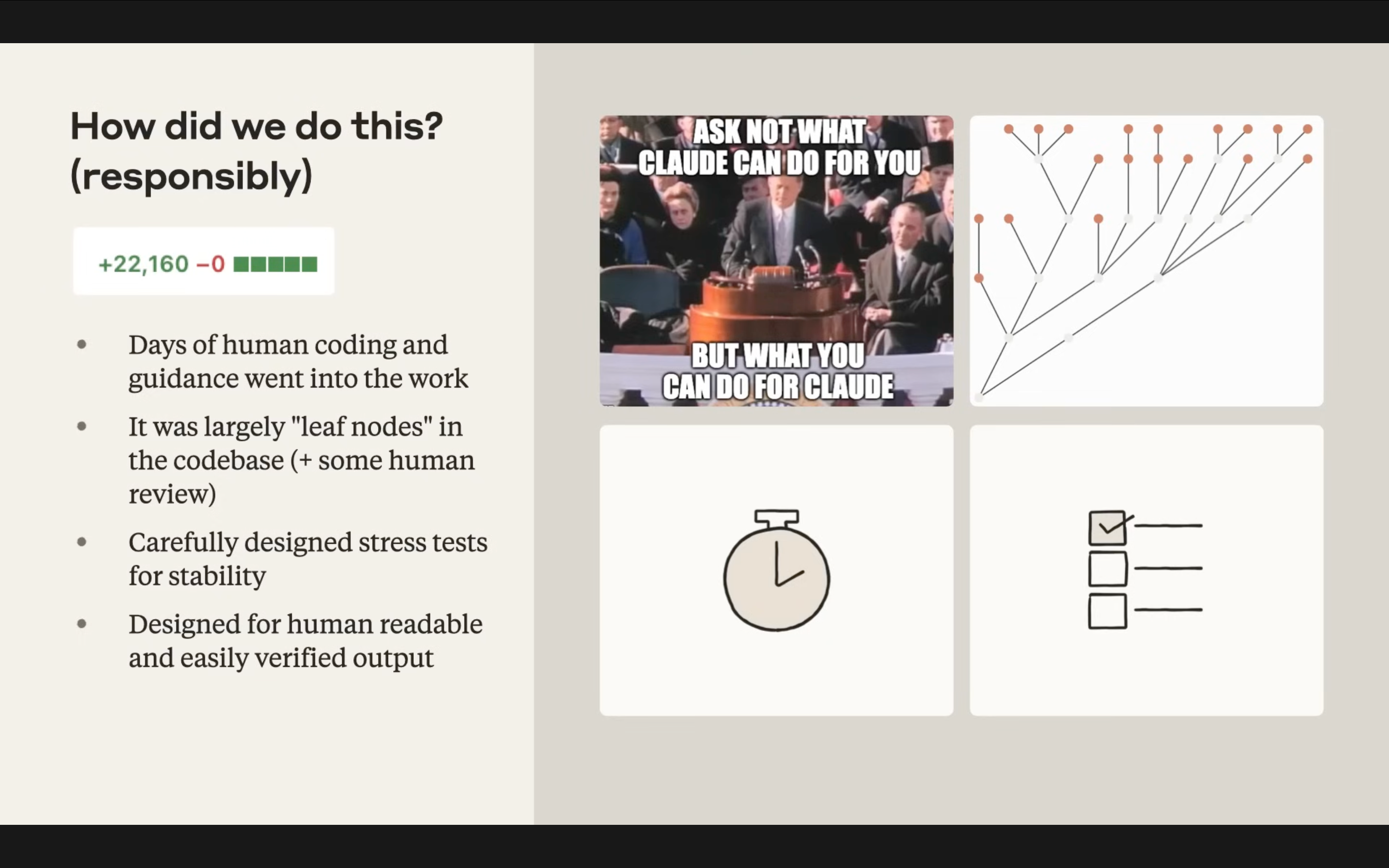
Because the system was designed to be easily verifiable, quality could be ensured without deep code understanding. Weeks of work completed in days with AI assistance, with full confidence in quality.
Vibe Coding Summary:
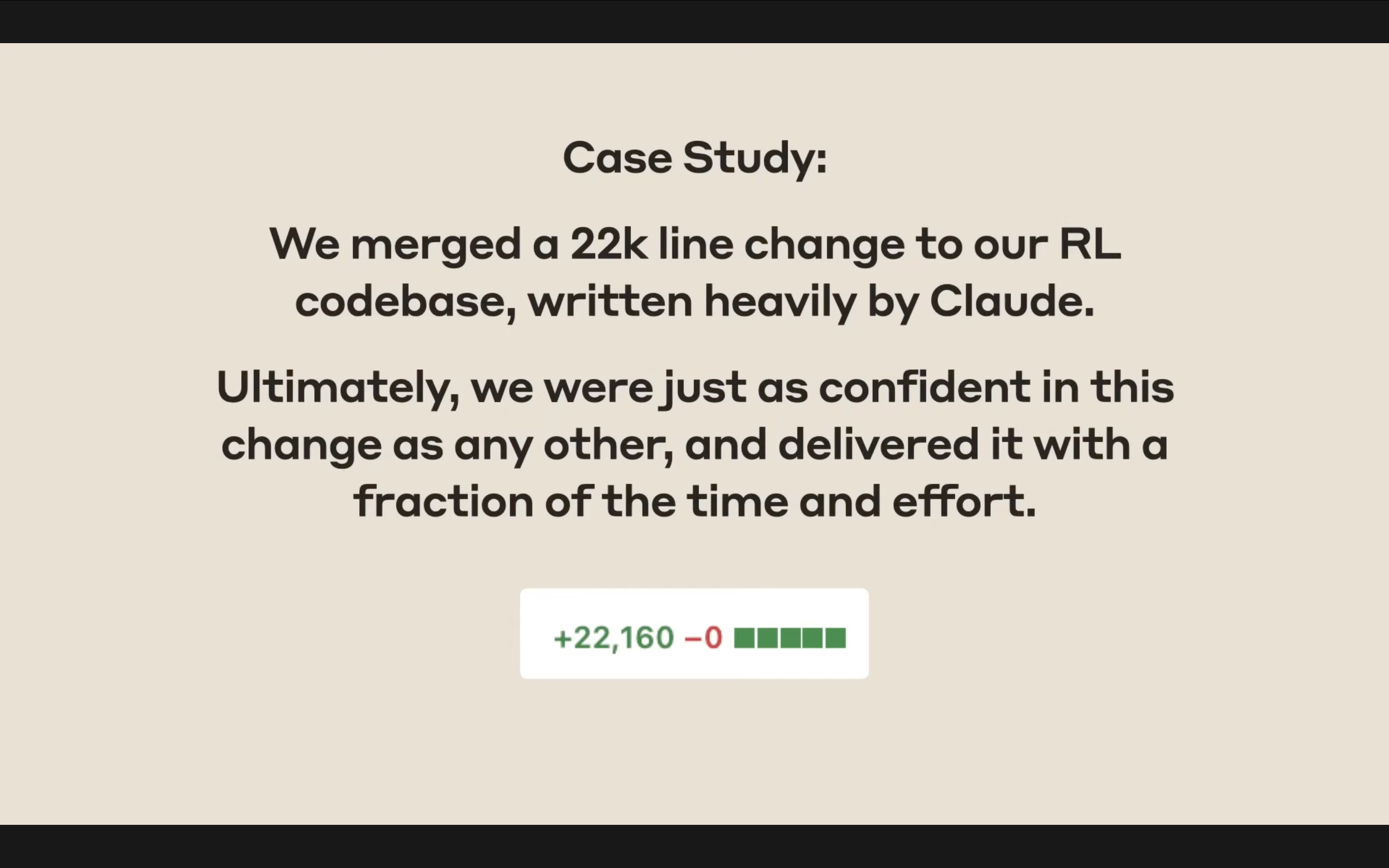
- Become Claude's boss — focus on what you can provide, not what it can do
- Apply Vibe Coding to leaf nodes; maintain human review for core code
- Design systems to be verifiable — ensure correctness without reading all code
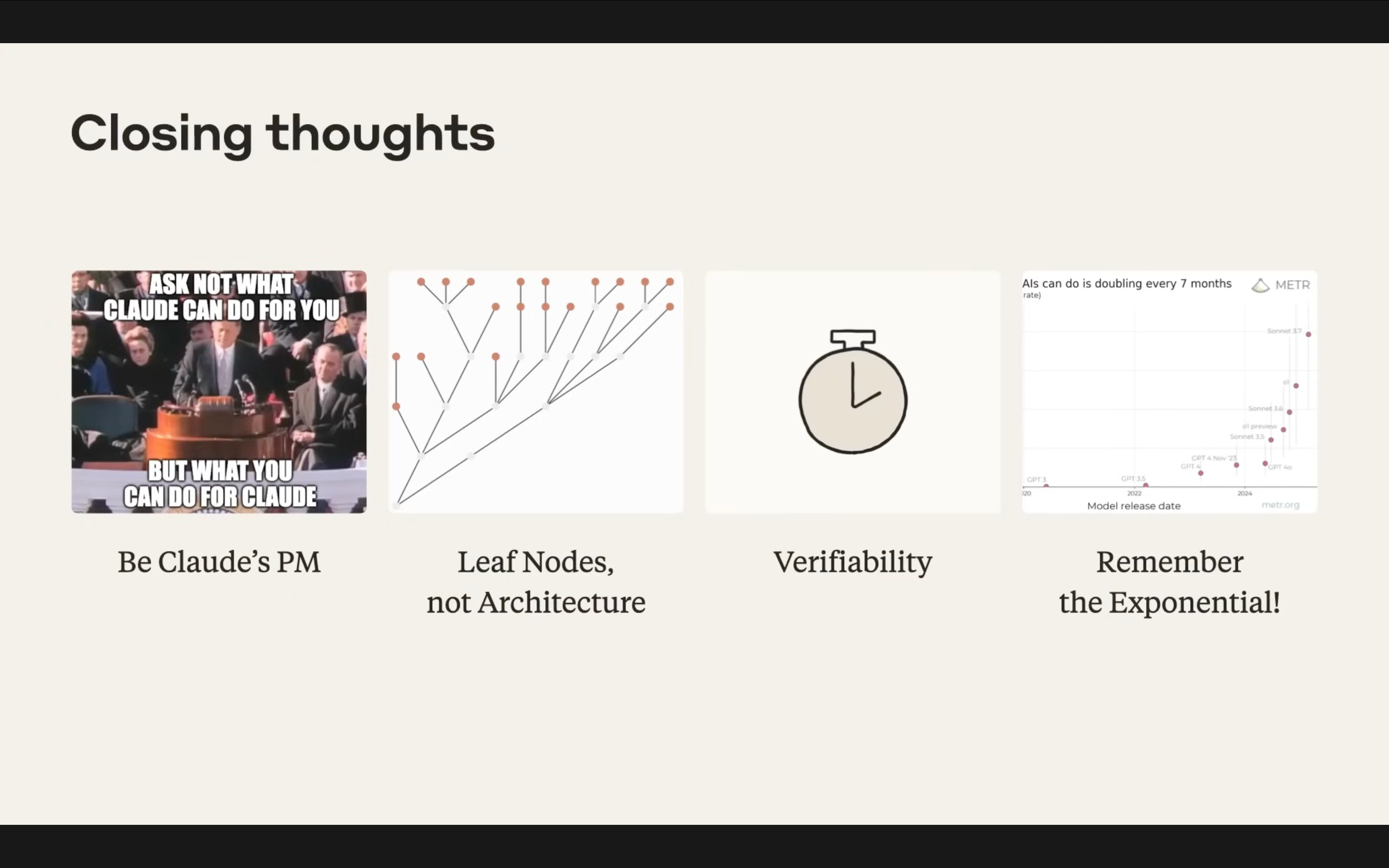
Remember AI's exponential growth. While reviewing every line of code works today, if AI can eventually generate a week's worth of code at once, line-by-line review becomes the bottleneck preventing us from benefiting from model improvements.
Q&A Highlights:
The session featured an extensive Q&A covering:
- Learning and skill development in the age of AI assistance
- Balancing information provided to AI (not too much, not too little)
- Security considerations in Vibe Coding
- Test-driven development with AI
- Embracing exponential growth in practice
- Workflow optimization (terminal vs IDE)
- Rapid code familiarization strategies
4. LLM Model Developments by Eden Ye
Eden Ye presented the latest developments in large language model architectures and capabilities, including:
- Model architecture innovations
- Performance benchmarks
- Real-world applications
- Industry trends

Featured Resources
Prompt Engineering
- Anthropic Prompt Engineering Video - Complete guide to production-ready prompts
- WTG AI Prompts Repository - Internal prompt engineering examples
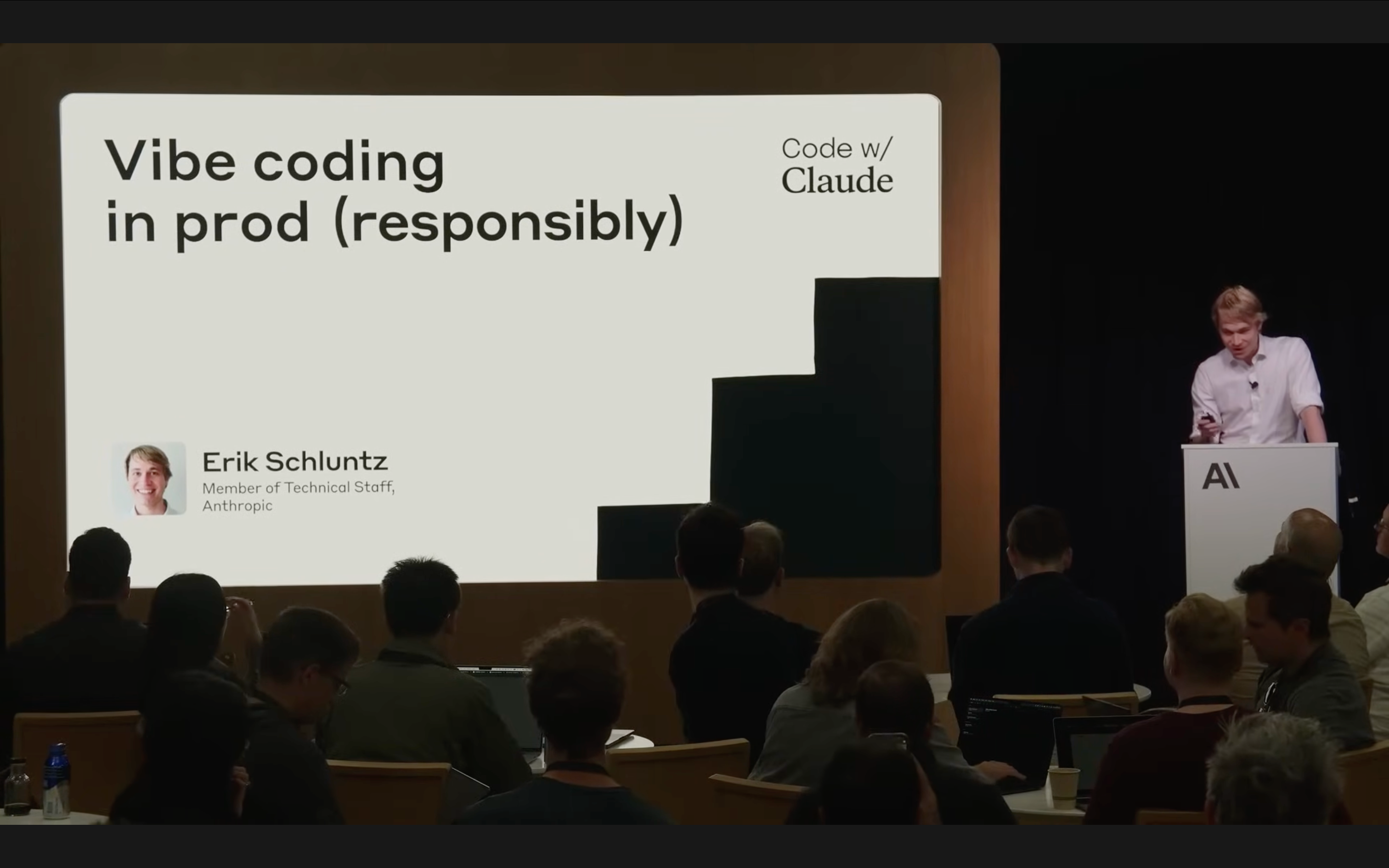
- Building Effective Agents - Anthropic's engineering guide
Vibe Coding
- Erik Schulntz's Vibe Coding Talk - Full presentation on production Vibe Coding
- DeepSeek Sparse Attention Paper - Native sparse attention research
- Kimi MoBA Paper - Mixture of Block Attention for long contexts
- MiniMax-01 Paper - Lightning Attention architecture
AI Agents
- Kimi K2 Technical Report - Open agentic intelligence
- ChatGPT Agent Release - OpenAI's latest agent capabilities
- Sequoia ChatGPT Agent Podcast - Deep dive interview
- Qwen3-Coder Blog - Agentic coding in practice
- Context Engineering for AI Agents - Lessons from Manus
Additional Videos
- Bilibili Reference Video - Related technical content
🏆 Quiz Results & Winners
🥇 First Place
Winner: Tyan Yin
🥈 Second Place
Winner: Jay Li
🥉 Third Place
Winner: Keen Qiu
📊 Full Results
| Rank | Name |
|---|---|
| 🥇 1 | Tyan Yin |
| 🥈 2 | Jay Li |
| 🥉 3 | Keen Qiu |
| 4 | Han Zhao |
| 5 | Elliott Li |
🔑 Key Insights
Prompt Engineering is Programming: Writing production-ready prompts requires the same rigor as writing production code — structure, examples, and clear specifications are essential.
Vibe Coding Requires Strategy: Don't apply Vibe Coding everywhere; use it strategically for leaf nodes while maintaining human oversight for critical infrastructure.
Design for Verification: The future of AI-assisted development lies in creating systems that can be verified at higher abstraction layers, not at the code level.
Exponential Mindset: AI capabilities are growing exponentially. What seems impractical today may be essential tomorrow — prepare accordingly.
Context is King: Whether prompting or Vibe Coding, providing comprehensive context is the difference between mediocre and exceptional AI performance.
📚 Further Learning
For those interested in diving deeper:
- 📖 Anthropic Prompt Engineering Guide - Comprehensive documentation on advanced prompting techniques
- 🎓 AI Agent Development Course - Learn to build production-ready AI agents
- 🔬 Large Language Model Research - Stay updated with the latest LLM architectures and capabilities
🎯 What's Next?
Looking forward to Session 3! Stay tuned for:
- More advanced AI development techniques
- Real-world case studies from WiseTech Global projects
- Interactive hands-on sessions
Missed this session?
All materials are available above, including the full video recording. Explore the resources and experiment with the techniques discussed!
Questions?
Have questions about prompt engineering or Vibe Coding? Reach out to the Crossroad AI team or join our internal discussion channels!
Session 2 | August 22, 2025 | Prompt Engineering & Vibe Coding | Crossroad AI Team